
REVIEW 2025 - WITH MARIA VASSILEVA
This year’s survey by the Journal of Social Vision gathers the perspectives of our colleagues, curators and critics, on the most important events and topics in art in 2025. We invited participants to point out the standout exhibitions, projects and figures, note key international accents, significant critical publications and media, as well as the disappointments that led to tension in the cultural environment. The answers we received are almost without repetition, while outlining the important topics and asking the questions that will likely move us in 2026. They speak of the dynamics, ambitions and challenges facing the contemporary art scene. For our part, we thank you for the personal perspective, candor and, last but not least, the enthusiasm, which we want to pass on.
We are starting the series with the answers by Maria Vassileva, curator, critic and art historian. In 2025, Maria curated the exhibition "Resurfacing" at the Art Gallery Kazanlak, Dechko Uzunov House Museum, Nenko Balkanski House Museum, Ahinora Museum. The exhibition, which can be seen until March 29, 2026, explores the tense state of the contemporary world, marked by conflicts, disinformation and erosion of trust, and poses the question of what must be left behind in order to move forward.
Key events during the year in Bulgaria
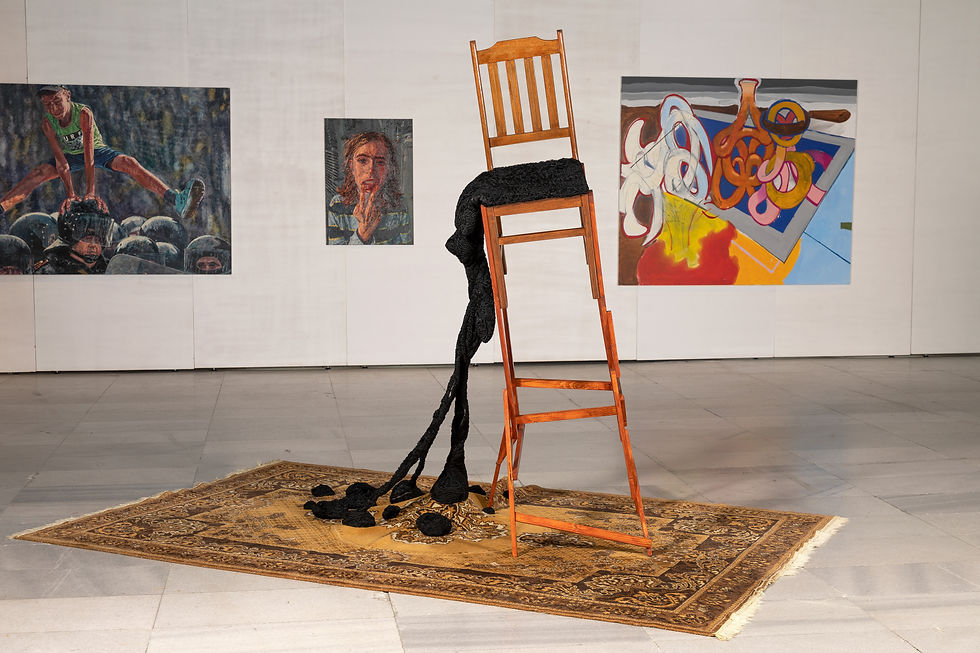
Krasimira Butseva "Cartography of Absence", ICA-Sofia, curator: Dani Radichkov, 28.03-27.04.2025
The exhibition poses ethical questions about collective memory in an unobtrusive but profound way. The exploration of absence acquires new nuances through carefully selected visual strategies. The role of the gallery as a producer of history is clearly outlined.
"Disturbances/Lost World" , Union of Bulgarian Artists - Shipka 6, curator: Slav Nedev, 29.04-29.05.2025
The curatorial framework proposes a rereading of social tensions through the language of visual arts . The project restores the role of group exhibitions within the Union of Bulgarian Artists as platforms for public reflection.
Dina Stoev "Chapter II" , Cube Gallery - Toplocentrala, curator: Vladiya Mihaylova, 3-31.07.2025
The exhibition's strength lies in combining emotional engagement with a clear aesthetic determination. The pictorial surface becomes a space of recognition and opposition.
Lachezar Boyadzhiev "On Vacation... Corpus Equorum" , National Gallery – Kvadrat 500, curators: Övül Ö. Durmuşoğlu and Joanna Warsza, 10.07.2025–28.09.2025
A vivid illustration of the interaction between the author's idea and the social context, which becomes an active carrier of meaning. The artist's interventions raise questions about mobility, identity and invisible structures of power.
"The Art of Collecting Time. The Donation of Gaudenz B. Ruf", National Gallery - The Palace, curators: Martina Yordanova and Maria Kodinova, 24.07-26.10.2025
An excellent example of philanthropy and a meaningful approach to collecting contemporary art, the donation functions as an archive of cultural gestures and sensibilities.
Sofia Art Fair, 2-5.10.2025
The event is not only a commercial platform. The forum stimulates meetings between different communities and creates conditions for critical dialogue. The professional lecture program turns it into a stage for the formation of discourses.
Krasimira Butseva, "Cartography of Absence", ISI-Sofia, 2025. Photo: Kalin Serapionov
Key international events
Tatiana Trouvé, Palazzo Grassi, Venice, 04/06/2025-01/04/2026
The scale and possibilities of the venue allow for a retrospective presentation of one of the most influential contemporary authors working with themes such as memory, time, and psychogeography.
Gerhard Richter, Fondation Louis Vuitton, Paris, 17.10.2025-02.03.2026
The project shows Richter's full range. The exhibition consolidates his status in art history and poses fundamental discussions about image, memory and painting today.
A book, criticism or media of particular significance in 2025
"Breaking the Silence. Methods of Writing Art History" , Clark Studies in the Visual Arts – the book is dedicated to Michael Ann Holly and changes the understanding of art history as a deeply humanistic discipline, in which philosophy, culture, anthropology, sociology, etc. are intertwined.
The biggest disappointment of the year
The absence of a clear state cultural policy. The limited visibility of Bulgarian art outside the country's borders. The lack of rethinking of the cultural heritage from the socialist era (through permanent exhibitions, temporary exhibitions or in theoretical texts).
Major themes for 2025
Collective memory and the reassessment of the past; heritage and national identity; crises of modernity and adaptation to uncertainty; ecology and sustainability.
What will drive us in 2026?
More radical practices – active attempts to rewrite, “remix” or “restore” historical fragments; accelerating interest in post-digital and AI practices; return of the body in opposition to conceptual and digital approaches; identity and nationalism; connection with political crises and greater social responsibility.


Comments