
TRANSFORMING AIRPORTS
Updated: Oct 10, 2025
Frank Quante, former CEO of Burgas and Varna airports, and artist Boryana Rossa reflect on their collaboration to bring art into airport spaces, creating environments that combine creativity, human-centered experiences, and a sense of inspiration for travelers. During his time at Varna Airport, Frank explored ways to integrate greenery and art, while Boryana created The Woman and the Universe, a sculptural installation inspired by flight, public art, and female figures. Viktoria Draganova asked the questions, highlighting how their work shapes the airport environment, engages visitors, and connects history, identity, and imagination in these public spaces.

Frank, you’ve been CEO of the airports in Burgas and Varna for the past five years, before you moved this summer to Antalya Airport. At what moment did the inspiration arise to work with artists there, to showcase art, and to create spaces that offer a different kind of experience?
Frank Quante: Let’s talk about it in a more general way, not only about working with artists. Approaching the space of an airport is something very special. I changed my sector when I started in Bulgaria – before that, I was in the energy sector. When I came to the airport, I sensed it as a unique place. For me, it is not only functional but also related to the dream of flying, which is as old as humankind.ьь To include this creative and human dimension – also the goal of beauty – is part of personal Manager DNA.
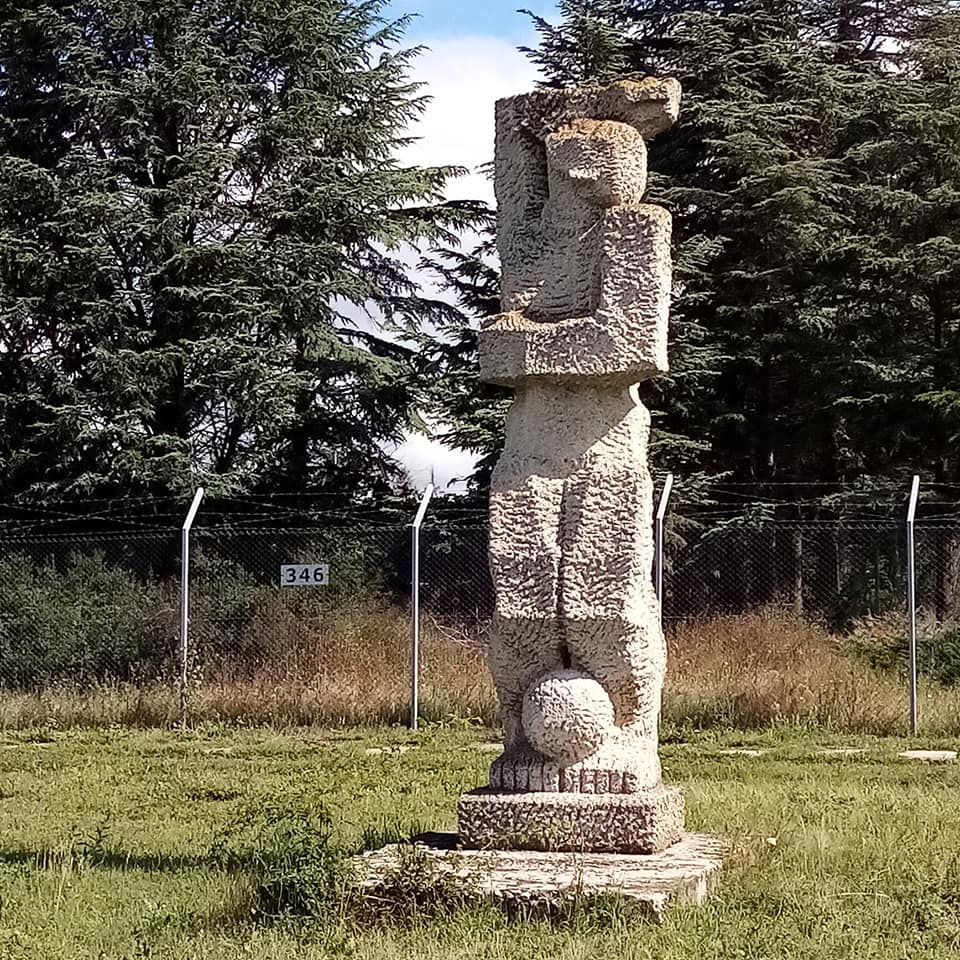
A few years ago, I saw at Varna airport this big three-meter tall sculpture, made during socialist times (The Man and the Universe (1975) by Nedko Krastev). We presented this art piece on the landside to our customers and employees, after the sculpture was not publicly visible for many years. Then, I showed Boryana this piece. This is where she got the initial inspiration from and said: “Let's pick up this dream of flying and make sure that it's not only a male dream, but one that has always been a dream of all humans.” That was the story in brief.
Boryana, upon the invitation of Frank Quante and the airport management you created the installation The Woman and the Universe. Where did your initial inspiration come from?
Boryana Rossa: The first inspiration came from the idea of flight, the idea of overcoming the ground and going to outer space. This is just something that must be considered immediately when you're making art for an airport.
Then, of course, the sculpture The Man and the Universe that Frank showed me. It is a piece that records the history of Bulgarian art in public spaces. I figured out later that this piece is part of a series of sculptures that Nedko Krastev made. In this series, he also has images of women, and children. I also really like Nina Kanarova’s sculptural works which I got familiar with during the process. She is Krastev’s partner in art and life. I have to mention here that while translating the title from one language to another we face a slight change of meaning. The most accurate translation of the original title Човекът и Вселената in English is The Human and the Universe. In the Bulgarian version we don’t have gender determination. Nevertheless, the sculpture in Varna is a male figure over a sphere, which is perhaps a planet, the planet Earth. For me, this sculpture is a beautiful metaphor about overcoming gravity, overcoming the roundness and going out of it, to the endless and shapeless Cosmos. Therefore, I thought, we need to include a female character here, because we don’t want to remain with the very stereotypical thinking that everything was done by the active men and that women are just the keepers of the ground, they are stuck to the earth where they give birth, and that's it.
And then came the tip of the wing, which was in Frank's office in Varna. This was the material that inspired me. One can begin with abstract ideas about flight, but eventually one must arrive at a material object. I asked if I could have more of these wings and began imagining a series of portraits of superheroines painted on them. I even considered a kinetic installation in which the wings would spin around their axis.
A wing is not like a wall, where you paint on one side and the other side simply remains part of the building. With a wing, you are already working in three dimensions—you are thinking of a rounded object, you must consider light. That is why I started to think of this piece as a sculpture, rather than a mural.
How challenging is it to display art in the airports?
Boryana: The airport is not a gallery space. Visitors don’t feel the intimidation of the “temple of art”, which is a good thing, but also creates some problems, such as that people are touching things, they stumble against things. When one makes public art, or art that directly communicates with a randomly present audience, either performance art or public intervention, one always thinks about the immediate, spontaneous and instant reaction of the people present. That's something I thought about as a performance artist before. But in terms of installing something in a public space, permanently, one must think not only about the immediate reaction, but the reaction afterwards.
What is it if you are spending a lot of time with an art piece? For instance, when you miss your flight or you wait for your flight for hours – and this art piece is hanging out right next to you.
This art piece must somehow communicate with you and perhaps inspire you or calm you down or just create a nice, engaging environment.
The presence of art and your engagement with it means that you will do something else, besides being stressed about missing your flight or carrying very heavy suitcases. This is its role, and it is an important one. We see some temporary exhibitions at the Sofia airport, for instance. Although it is becoming better for the last couple of years, it has been one of the more depressing airports I know, and not only because this is my departure point from Bulgaria. I speak both as an artist and a customer. It would be nice if the airport management engages professional artists and curators to do artwork and invests in it. I would love to participate myself. Then this would be my favorite airport – the one on which I come back to Bulgaria, again and again.
Frank: At some point during our project, the question came up: Where do we display the sculptures and make them visible to passengers without disturbing the workflow? Doing projects at airports is never easy. You must consider various aspects, for sure safety, security, passenger flow and operational needs. Burgas and Varna are very much touristic airports. In the summer they are very crowded. And the operational teams are fighting for each square meter. Boryana´s sculpture is a heavy piece, yet, it also has a certain fragility, and it's sensitive on the surface, so touching it, having access to it – all these things had to be considered.
How do art and artistic interventions transform the experience of airports?
Frank: The idea of showing art emerged largely from the fact that, in Bulgaria, many public areas and buildings are visibly deteriorating. In the beginning, the intension was to foster a sense of identity and community-ownership around public space. We started a project at the airport with our employees called My Airport. Part of this was giving employees an opportunity to improve their working spaces. Another project we started to lift the depressive spirit during COVID, was a project of planting 5,000 roses at each airport. And we integrated all business partners, as well as the local community. Even private persons came and said: "Good idea, I am giving you ten roses to plant.” This created a nice dynamic and now there are about 10.000 roses at each airport. The uniforms of our employees have the rose as a stitched symbol.
From my point of view, functionality has become too dominant in many things we do. The human dimension is not present in a way that is satisfying, or should be.
We also started the Gate Gardens (an area after passing the passport control outside the building garden with shops, plants and benches.), adding another dimension, which is sustainability in an ecological way, while also allowing a different stay at the airport by waiting outside, seeing the aircrafts and the runway. These outside areas are saving 75% of CO2 emissions compared to a closed space. And it's also economically attractive. It's a win-win-win for airport, passengers and nature. Art and greenery – as the Gate Gardens – have an impact on our passengers. While airports are very highly functional and often stressful, green is calming and brings peacefulness. The airports now bring green into the terminals to calm down passengers, including children. We went the other way. We didn't bring the green into the terminal, but we brought the terminal into the green. The commercial partners we integrated were very positive and supportive about this idea.
Boryana: I fly a lot, and sometimes I get stuck at airports. When traveling from the United States to Bulgaria, we usually have a connecting flight. It’s hard. You must find a way to keep your energy up, avoid falling asleep, not get depressed, and eat something nice just to survive the long journey. It’s tough.
Thinking about this personal experience helped me to connect everything: on one side Frank's idea of creating a better experience of the airports, and on the other side conveying the inspirational idea of flight. Being inspired by the machine, the actual machine that brings you up in the air that has been created by people.

Boryana, your installation places particular emphasis on the female figure – what concepts underpin this focus?
Boryana: I had the goal to bring together, through my art, the machine body and the people who created it and fly in it, who gave it a spirit. I also had to emphasize the presence of women – both real and mythological. This is how the initial idea of the superheroines transformed into those images of women flying, which I painted on the body of the airplane. This metal body, which we obtained from the airplane, underwent an alchemical transformation—from something that flies and has a function into something that may not fly physically, but inspires and awakens the spirit of flight. I also chose to create a specific contrast between the shiny surface of the wing (Frank said they polished it with orange peels, which contain essential oils) and the matte surface of the paint, to emphasize this duality and, at the same time, the symbiosis between the machine and human beings.
To create the female figures, I studied the movement of the body in zero gravity, which is very similar to how the body moves underwater. As I recently learned, cosmonauts prepare for zero gravity by training in water. This is how the connection between air and sea—so central to Burgas, and one of the main reasons tourists visit—became intrinsic to these images. They fly, swim, and overcome gravity at the same time.
Finally, Dragomir Georgiev, one of the directors of Burgas Airport, told me about an art piece that once stood on the façade of the old building before it was demolished: Icarus, 1968 by Doko Dokov. It is a beautiful, fragile-looking, androgynous figure in flight. I am a big fan of the aesthetics of the 1960s, and this work inspired me to imagine a female parallel to Icarus in mythology—one that is not so tragic.
That is when I discovered Elektra, the Ocean nymph, the Oceanid who gave her name to electricity. Electricity is not only the driving force of airplanes but also the vital energy of the human body. It is omnipresent. This became the key element connecting flight, water, and technology with a strong and inspirational female figure.
Was it also important for both of you to explore the history of public art in airports?
Frank: Across Europe, many airports incorporate art, but Bulgaria seems to have lost a bit of the spirit of integrating art into public spaces. The country did this before, looking back over my five years, the art I saw in public buildings was always socialist art. Seemingly, this stopped after 1989.
Boryana: During socialist times, public institutions were obliged to buy or commission art pieces. This doesn't exist anymore. For me, as somebody who graduated from the Mural Painting department at the National Academy of Arts in 1997, this change of policy that excludes art was a big pain. There was no place to do anything, there was no place for my art, there wasn’t any way for me to survive as a muralist. That's why I gradually moved to other fields of art. This is a different topic about which I talked in other places [1].
Generally, it is a question about the existence of contemporary public art in Bulgaria.
There are murals in churches that follow the Orthodox canon, and there are some murals created by graffiti artists. In the Sofia subway, there is hardly anything—apart from works by Boyan Dobrev, one of my professors, a sculpture of Orpheus by Krum Damianov, and perhaps a couple of other pieces. Across the country, contemporary public art is very scarce, almost invisible, especially compared to previous epochs.

How was the project funded and how can we bring public art back into airport spaces?
Frank: I think the main sponsor was Boryana with her enthusiasm for this project. The installation was done and financed by the airport; the wings were a donation from Electra airline and their MRO company. Also, our team was highly motivated and worked with enthusiasm, which I see as a strong contribution.
As for good examples from other countries about art in public spaces: in Germany, every public building has a percentage of the budget dedicated to art. Depending on the financial budget of the project,0.5 to 1.5% has to be spent for art. And that is why public buildings in Germany have integrated art and can work with well-known artists.
In our case, what I like about the project is that it's completely “home-cooked”. All the ideas came from Boryana and our team. It is a real Bulgarian project, with an international dimension and also references to the history of our airports, as Boryana mentioned. “Woman and the Universe: Elektra” is part of the airport now, part of its identity.
It's important not to limit innovation to technology, but to extend it also to social concepts, including art.
Boryana: What can we do to bring art back into public spaces? How can we make it happen more often, and have it be a policy? Frank shared the German model, which I think is excellent. Bulgaria once had a similar policy as well. It is fundamental to have this kind of commitment at the governmental level, the city level, or at least within private organizations. With such dedication, there is this chunk of money allocated specifically for this purpose, and people who think collectively about how to achieve it. This is fundamental.
The other crucial element is, of course, the people. They must develop their own vision—who they are, how they want to present themselves to the world. This becomes a matter for those who inhabit the place, who go through and who work there. That’s why I spoke about Frank, as someone who has a clear idea of what he wants to achieve, why he needs art, and how it shapes the identity of a place.
What we are discussing now reminds me of part of the old Burgas Airport, built in the 1960s and later demolished for functional reasons. Dragomir Georgiev, one of the directors of the airport I mentioned already, with whom I had great conversations throughout, told me about a large staircase in that building. He said the people who once worked there always remembered it as something inspirational. It is designed in a style typical of the 1960s, it spirals up. I am convinced that its upward movement, combined with the light coming from above—a purely visual and tactile experience, independent of function—made people remember it and associate it with the spirit of the airport. Unfortunately, the staircase was not functional enough to preserve, but it still lives on in people’s memories, embodying the spirit of the airport.
Here I must also mention the architects I worked with: Alexander Georgiev and Kalin Kanev, who also worked on the Gate Gardens at both airports. The collaboration between artist and architect is essential for shaping not only the experience of the space but also the identity of the place. And the relationships with people who work there, like Dragomir or Veselina Kotavova—who supported the realization of the Burgas project from the very beginning – are so important that the artwork is taken close to the heart.
Frank: When Boryana talks about state policies: I think it's now 10 years ago when more than half of the 50 biggest entities in the world switched from being countries to being private companies. We always tend to shift the responsibility to the state a little bit, and I'm not against it. But I also see the work with art as part of the responsibility of the business leaders.
It's important that management and leadership education include social responsibility, art and creativity. Not to limit innovation to technology, but also to extend its social concepts, including art.

Frank, you recently moved to Antalya Airport. Do you already plan artistic projects there?
Frank: Well, I just started my new position 4 weeks ago and Antalya is a very different asset, a different region and a different ecosystem. I want to understand this much better before I plan and consider how to integrate artists. But Fraport is also doing projects at other airports, for example in Lima, and I will definitely present proposals to our team and the Board of our company.
In any case, this project with Boryana really was a big learning experience for me. It was not my first one, but it was the most artistic one. Boryana is really an amazing artist, and I hope she continues to influence her home country Bulgaria! And I want to thank the team of Fraport Bulgaria that supported the project, especially Veselina Kotavova and also Aleksandar Georgiev, Kalin Kanev and Dragomir Georgiev.
Boryana: Thank you!


Comments